Russian Constructivist Font

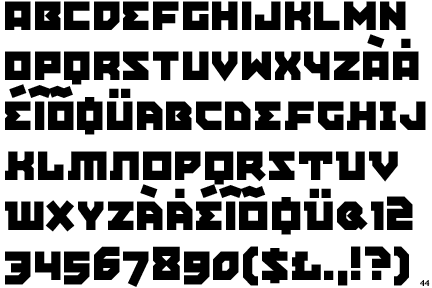
Archive of freely downloadable fonts. Browse by alphabetical listing, by style, by author or by popularity. Constructivism was a groundbreaking movement in art, design, and architecture that began in Russia in 1913, but really rose to prominence after the Russian Revolution. Font mavens of the world unite! Constructivist recreates the bold graphic design of early Soviet Era Russian Artists such as Rodchenko and Popova. The Constructivist f.
About Constructivist Font mavens of the world unite! Constructivist recreates the bold graphic design of early Soviet Era Russian Artists such as Rodchenko and Popova. The Constructivist family contains 5 fonts plus a set of decorative extras. Constructivist Pro is an Opentype adaptation of the P22 Constructivist Set font system which combines the 5 font styles and adds Opentype features such as alternate Latin and Cyrillic letterforms, full Central European Language support and changes in line spacing and optical sizing of some characters for improved harmony. In all over 1200 Glyphs for maximum flexibility and design choices. Seize control of the means of desktop production with this revolutionary font collective!
Movie poster for Ninich, by Vladimir and Georgii Stenberg, 1927. Constructivism was a groundbreaking movement in art, design, and architecture that began in Russia in 1913, but really rose to prominence after the Russian Revolution of 1917. This revolution was a time of great dissent and change, leading to the dismantling of the Tsarist regime in favor of the Bolsheviks. Russian Constructivism was considered more of a philosophy than just a style, and reflected a belief in art for social change rather than personal expression.
The Russian Constructivists were proponents of functional art and design rather than decorative, expressive art (such as easel painting) that was hung on walls. This echoed the revolutionary mood of the times where the bourgeois culture was being replaced by the revolutionary proletariat movement. The tools and techniques of the more traditional, figurative painting and art styles were replaced with “constructed” photomontages and strong typography. Russian Constructivism characteristically had minimal color palettes, often just red, black and sometimes yellow. They frequently had diagonal elements with circular and angled type and images. The resulting work was extremely dramatic, containing layered images coupled with powerful type treatments.
This work was exciting, often jolting, and even shocking, which was in line with their goal to change society. This movement was a dramatic shift from previous, more conventional movements and philosophies of art. Although originally intended for political messages, the Constructivist style seeped into product advertisements and posters of all kinds, as well as book covers and their interiors. Hammerli 208 Serial Numbers.
Three of the most influential designers of the Russian Constructivist period are Alexander Rodchenko, the Stenberg Brothers, and to some extent, El Lissitzky, a Futurist who influenced the Constructivist movement. Here is a little background and a sampling of their work. Most of the work speaks for itself, but I have provided explanations for those that call for it. Alexander (Aleksandr) Rodchenko (1891–1956) This Russian designer, photographer, painter and sculptor was considered one of the founders of Russian Constructivist movement. In fact, the term “constructivist” was originally coined by the artist in reference to the work of Rodchenko.