Virtual Breadboard Tutorial Pdf
Virtual Breadboard is a software platform designing ‘Breadboard’ form-factor electronic circuits and developing the. VBB-STUDIO User Manual (). That’s such bummer, as I don’t know if it’s a feature of my breadboard or not. So, what kind of breadboard you use in this tutorial?
Skill Level: Beginner by January 01, 2001 So you want to start burning your own PICs? We've written a short tutorial to help get you started.
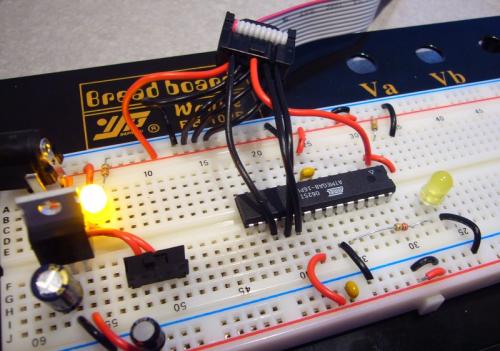
We assume you are starting from scratch. We tried to write it for the beginner with little knowledge of bread boarding - skim as you see fit. What you need: • PIC Programmer - We will use the PIC-PG1 low-cost serial programmer • Programmable PIC of some flavor - 16F628, 16F873, 16F877 • Voltage Regulator - LM317 variable or 78L05 • Power Supply - 8V 'Wall wart' or above • Multimeter - You just can't leave home without it! • Hook-up wire - 22 American Wire Guage (AWG) wire works well • Bread board - Used for quick prototyping • Needle Nose Pliers - It can be tough jamming things into the bread board Alrighty - so you've got most of what's on the list and you are ready to get going. First you have to set up the power circuit. Power Circuit - Most of the circuits you will deal with operate on a 5 volt DC supply.
Eee Pc 701sd Operating System. Your house is 120 volts AC. How to make it work? Get a ' Wall Wart'. These are the large black boxes you plug into the wall to power your cell phone charger or cable modem. Checkout the label some time. It should say something like: • Input: AC 120V 60Hz • Output: 12V 500mA If you plug this transformer (wall wart in engineering speak) into the wall, the cylindrical plug will output 12V and be able to source 500mili-Amps.
World circuit on the NI ELVIS breadboard. For a detailed tutorial on. Manual pdf wackerly.rar arduino toolkit for virtual. Dvd virtual breadboard.
If you are shopping for one, try to find one between 8-20V and 300mA to 1A DC. The Amp rating is not important for your first project. Blinking a light and running the PIC will only require ~20mA. A minuscule part of your transformer's ability.
But if most of the circuits run at 5V what are we doing with 12V supply? The wall warts produce a very 'noisy' 12V. We will clean that up with a voltage regulator. If you apply some noisy voltage to the V IN pin, you will see a relatively clean 5V on the V OUT pin. What you want to do is attach the positive line from your wall wart to the input pin of the VReg. Attach the ground line of your wall wart to the ground line of your bread board.
Then plug a wire from the 'Output' pin to the power strip of the bread board along with a wire connecting the 'GND' pin to the Ground strip of the bread board. All Voltage Regulators require 2-3V of ' over-head' voltage. This means that you must throw a few more volts on the input than what you are using on the output. This is because the internal circuitry has losses. If you try to pass 5-6V through a 5V regulator, nothing will break, but you will only see an iffy 4V on the output side. Try to give the 5V regulator at minimum 7.5V. Whip out your trusty multimeter, plug in the wall wart, and measure the voltage between the high and low power strips on the bread board.
You should read a voltage around 5V. Alice Madness Returns Demo Pc more. It is a good idea to hook a.1uF Capacitor between the high and low lines. This capacitor helps reduce any AC transients in the system. The cap acts as a surge suppressor. When your roommate kicks on the blender and the lights go dim, the wall wart is going to pass a mild power spike to your circuit.
The voltage regulator will suppress most of this spike, the capacitor helps suppress it even more. Zeosdbo 6 6 6 Stablegate. The power circuit with the power strips conjoined All ways test your power circuit before putting a microprocessor near your board. If something is hooked up wrong, or backwards, ICs can instantly fry.
You will not see any smoke, but you will be scratching your head for hours trying to figure out why the darned thing doesn't work. Warning - If you smell something odd or sense heat coming off the voltage regulator, immediately unplug your circuit. If you have a short of some kind, the VReg will begin to pass all sorts of current. This current turns to heat and causes the VReg to heat up dramatically. I have burnt my finger a number of times 'testing' the VReg. Under normal operating conditions, the VReg should barely be noticeably warm to the touch. If this is not the case, unplug and check.